Augusta Raurica
At Augusta Raurica near Basel, the AR Experience brings the ancient Roman city back to life by layering digital reconstructions directly onto the archaeological site. Visitors stand among 1,700-year-old ruins while seeing buildings, interiors, and inhabitants reappear around them in vivid 3D.
Tamschick Media + Space developed an app-based AR journey, transforming archaeological research into a site-specific narrative where ruins remember and history becomes spatially present.
AR as an archaeological lens
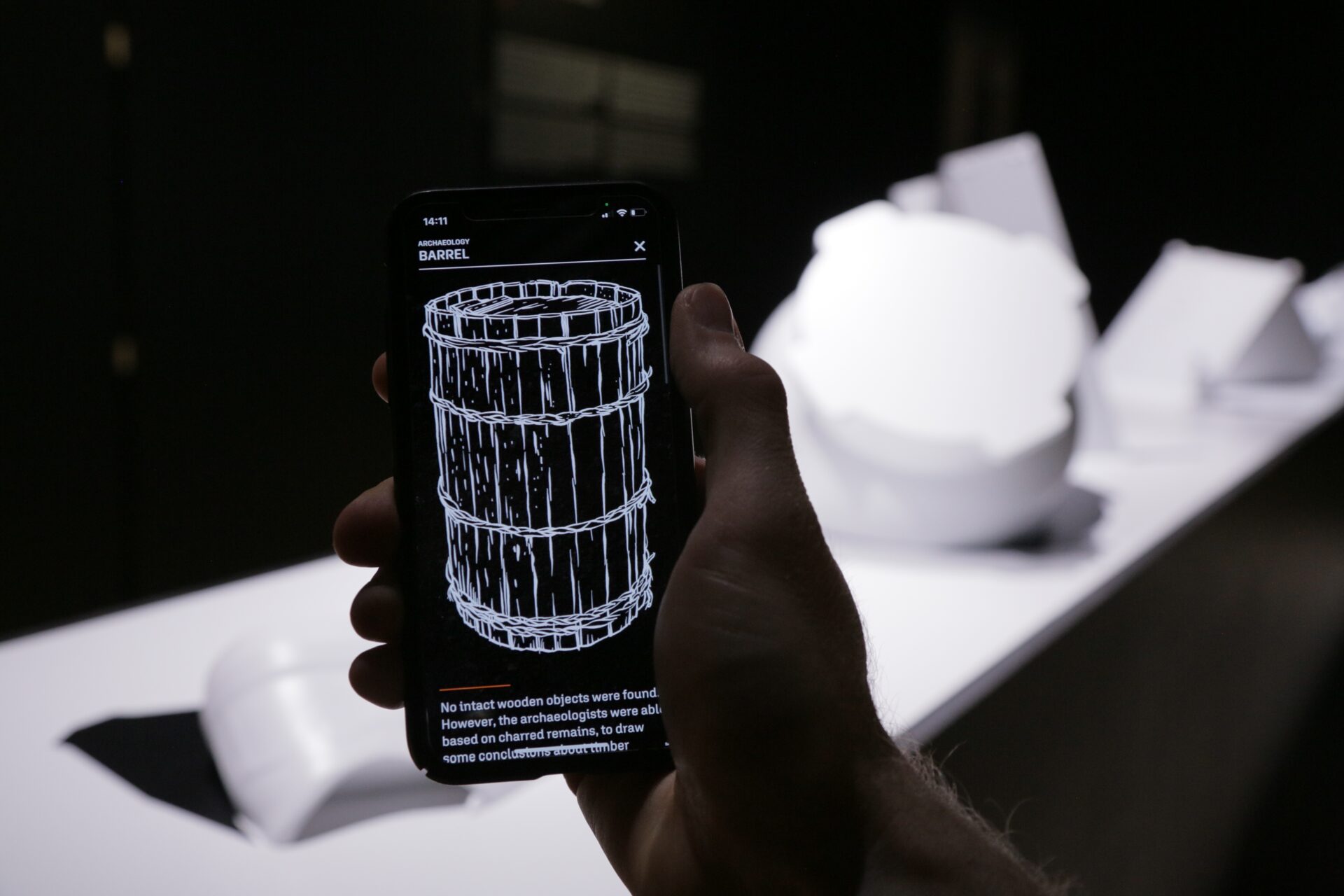
Visitors’ smartphones and tablets become portals into the Roman past, precisely aligned with the excavation through 3D tracking.
Digital reconstructions show how people once lived, worked, and celebrated in Augusta Raurica. Architecture, interiors, and atmospheric details are rendered in 3D, supported by lighting and soundscapes that evoke everyday life and extraordinary events. Two buildings destroyed in a historic fire are digitally rebuilt, allowing audiences to move through their spaces virtually and understand their construction and role in the city.
A sculptural installation of original finds anchors the experience in material reality. Objects from the excavation are linked to short, focused stories that invite reflection on traces that civilizations leave behind.


Walking a Roman street twice – then and now
Equipped with the AR app, visitors wander through the ruins and see Roman spaces reappear exactly where their foundations lie. As they move, their devices overlay animated scenes onto the excavation: façades rise, rooms fill with light, and figures animate the streets and interiors.
The experience connects ancient craftsmanship with contemporary technology, bridging seventeen centuries of human imagination and allowing visitors to feel they are moving through a city suspended between past and present.


Making the ruins of a city legible again
Augusta Raurica holds one of the best-preserved Roman sites in Switzerland, yet much of the former city exists only as foundations, fragments, and specialist knowledge. The challenge was to reveal the full scale and atmosphere of this urban landscape without overwhelming the authenticity of the ruins.
The exhibition needed to connect rigorous archaeological research with a broad public, from families to history enthusiasts, using contemporary technology that feels intuitive on site. The goal was to create an experience that respects scientific accuracy while turning the excavation into a living, accessible environment rather than a static field of stones.


The AR Experience redefines how visitors engage with archaeological ruins. By merging archaeological truth with digital imagination, it transforms the site into a sequence of living spaces that deepen understanding of Roman urban life and its legacy.
The project positions Augusta Raurica as a pioneer in digital heritage interpretation, demonstrating how to enhance scientific communication on site while preserving the integrity of the excavation.
Project Highlights

- App-based AR experience with on-site 3D tracking that anchors digital reconstructions precisely to the archaeological remains
- Digital rebuilding of historically documented fire-damaged structures, enabling visitors to explore lost architecture in situ
- Sculptural object installation connected to story-driven digital content, linking physical artifacts with their reconstructed contexts
- Integrated light and sound design that extends the AR narrative into the physical environment of the excavation
Facts & Figures
Content curation: Augusta Raurica
Script and Dramaturgy: SchillerWendt
Exhibits: KPM3 Berlin GmbH
Architecture: Hess Architektur AG
Software Programming: neoanalog
Voice Over Recording: Mixwerk Media Solutions GmbH
Light Planning: Lichttransfer
Links


