Time Machine
Visitors step into the world of King Helv during the Spring and Autumn period, the same era associated with the strategist Sun Tzu and The Art of War, and experience the rise of the Wu Kingdom as an all-enveloping media narrative.
Live-action martial arts scenes filmed in Shanghai merge with ink-style animation, mirrors, and spatial sound to dissolve the boundaries of the room. The result is a time-travel experience where legendary battles, court intrigues, and turning points in power unfold as if they were happening around the audience.

Boundless Martial Landscape
TMS conceived the space as a boundless, mirrored landscape where film and interaction share a single visual language.
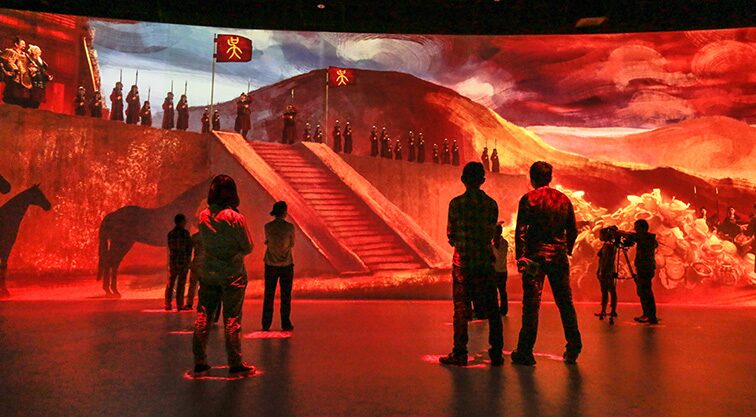
Twenty-two high-resolution projectors cover floors and walls with continuous imagery, reflected endlessly in floor-to-ceiling mirrors. Fourteen tracking cameras follow visitor movement, allowing real-time 2D and 3D graphics to react to people as they walk through the story world.
The visual style combines choreographed martial arts scenes with brush-like animations inspired by traditional ink painting. This aesthetic bridges contemporary film language with historical association and subtly connects the narrative to the strategic, almost choreographic mindset that later texts such as The Art of War describe.


Walking Through a Wu-Era Epic
Over a 15-minute sequence, visitors move through the legendary rise of the Wu Kingdom. They accompany King Helv’s ascent to power, witness the struggle for regional hegemony, and experience decisive moments such as the Battle of Boju as the room shifts through fire, steel, and ink.
Interactive elements trigger changes in the environment: footsteps wake up ripples in fields of light, formations react as if to approaching armies, and scenes expand or contract depending on where visitors stand. A 30-channel spatial sound design binds the visuals into a coherent emotional arc, supporting each transition from court to battlefield to aftermath.
The impression is less of watching a film and more of moving inside a strategic, war-torn landscape from the age of King Helv, the same historical horizon in which Sun Tzu’s world is placed.


Wu History Lived and Felt
The task was to transform dense historical material about the Wu Kingdom into a compelling large-scale visitor experience for a mixed audience in China.
The installation had to communicate the rise of King Helv, key battles such as Boju, and legendary stories from the Spring and Autumn period without feeling like a history lesson. It also needed to integrate real-time interactivity on a very large projection surface while preserving a clear, cinematic narrative arc.


Time Machine sets a benchmark for large-scale interactive media in Chinese museums, frequently cited for its integration of martial-arts cinema aesthetics, tracking-based interaction and mirrored spatial illusion.
It offers a clear entry point into the history of the Kingdom of Wu, extending visitor dwell time and positioning the Helv Relics Museum as an example of how regional history can be staged with contemporary media. The immersive experience is still open to public after 12 years.
Project Highlights

- 650 m² fully projected interactive media space with mirrored walls
- 15-minute immersive cinematic storytelling
- Visual style mixing cinematic martial arts footage with ink-style animation
- Real-time interaction via 14 tracking cameras and more than 30 synchronized computers
- 22 projectors and 30-channel spatial sound creating a boundless, reactive environment
Facts & Figures
Lead agency: Acciona Producciones y Diseño
Hardware planning / technical implementation: Kraftwerk Living Technologies
Music and sound design: Bluwi Music and Sounddesign
Historical research, client liaison, film production services: Red Gate International
Awards
Links